
Manual therapy
Mobilisation of the cervical and thoracic spine and of the joints of the shoulder girdle.
After eight hours at the screen your neck is stiff, your shoulders creep up towards your ears, and by the evening a headache sets in at the base of the skull. It is one of the most common reasons people working in the offices of Wola and the city centre come to see us.
The problem is rarely in the neck alone. Usually there is restricted thoracic spine mobility behind it, weak deep neck muscles and scapular stabilisers, and several hours a day in the same position.
So alongside working on the tension, we also look at what happens between visits: how your workstation is set up, the breaks you take, and short sets of exercises you can do at your desk.
We match the methods to what the assessment shows — usually combining several of the following.
Mobilisation of the cervical and thoracic spine and of the joints of the shoulder girdle.
Work on tight neck muscles, the trapezius and the muscles between the shoulder blades.
Thoracic mobility work and strengthening of the scapular stabilisers — as short sets you can do at work.
Local work on chronic tension in the shoulder girdle.
Support for the position of the shoulder blade and relief for the neck between visits.
Learning calm diaphragmatic breathing, which takes the strain off the accessory muscles of the neck and shoulders.
Licensed physiotherapists with a PWZFz licence number.

Oleksandr
MSc Physiotherapy
PWZFz no. 70983

Anita
MSc Physiotherapy
PWZFz no. 86026
The symptoms below are not an indication for physiotherapy. If you have any of them, contact a doctor urgently or go to the emergency department (SOR).
If your condition suddenly gets worse, call 112. If we notice any of these signs during your assessment, we will not start therapy and will refer you to a doctor.
The items from our price list we use most often here. We discuss the final plan and the cost of therapy after your consultation — before you decide to start.
Sometimes it does settle with rest. But if it comes back every week, the cause lies in the load and in the way you work — and a break alone will not be enough.
Some headaches do originate in neck muscle tension and restricted neck mobility. During the assessment we check whether your pain can be reproduced from these structures. If the picture is different, we refer you to a doctor.
The first consultation with the assessment takes 45 minutes. Individual therapy is available in 45, 60, 75 and 90-minute sessions — we match the length to how much work is needed.
Yes. We put together short sets you can do at your desk, and we advise on how to set up your monitor, your chair and your forearm support.
Symptoms often overlap — these pages may help too.
Low back pain, morning stiffness, pain when you bend — we look for the cause, not just quieten the symptom.
See detailsDisc bulge and herniation, pain radiating into the leg or arm — therapy guided by your symptoms, not by the MRI report alone.
See detailsBreathlessness on exertion, reduced fitness after an infection, shallow breathing — work on the diaphragm, the ribs and your tolerance to exercise.
See detailsBook an appointment
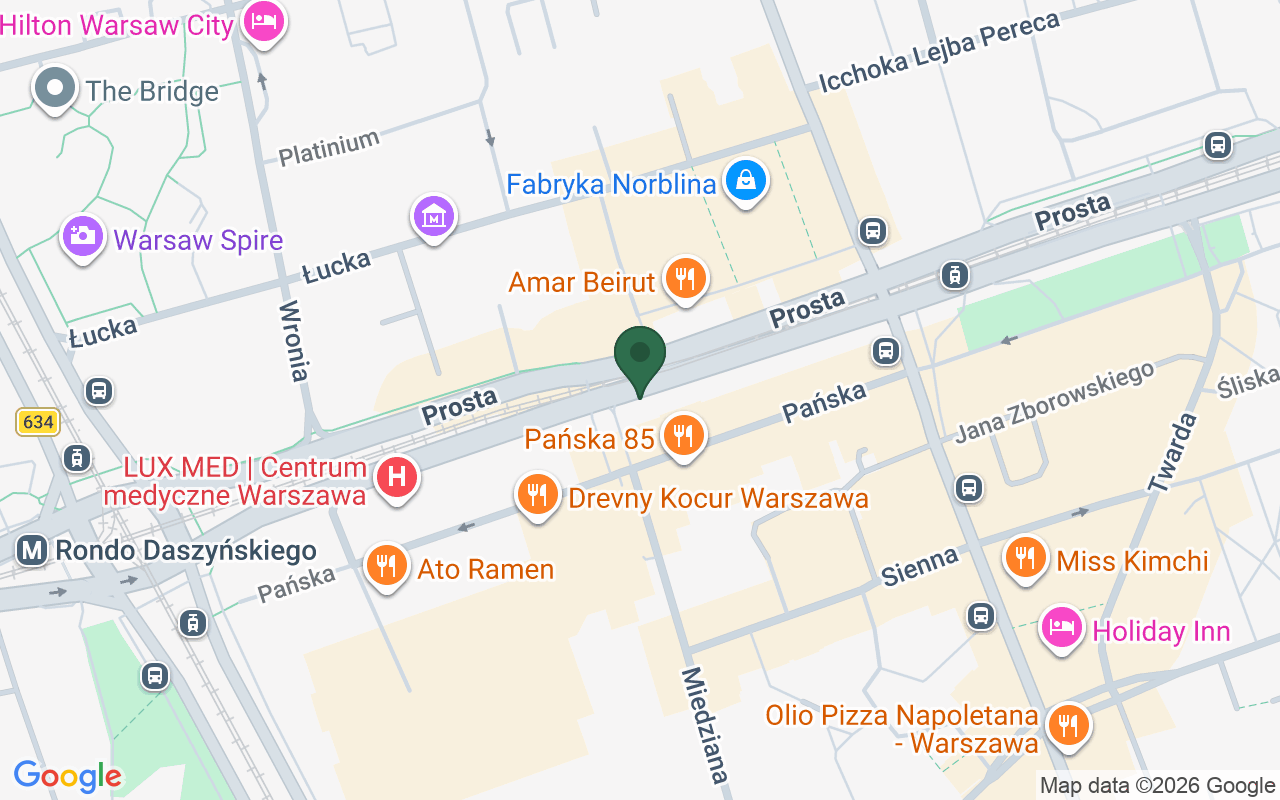
At your first visit we examine you, look for the cause and set out a therapy plan together with the expected cost. We see patients in central Warsaw, a few minutes from Rondo ONZ metro station.
Request
Leave your details — we call back the same working day, answer your questions and offer a consultation time.
Prefer to talk right now?
+48 573 323 068Contact
We're here to help you get back to full health.
This page is for information only and does not replace a medical consultation or an individual physiotherapy assessment.